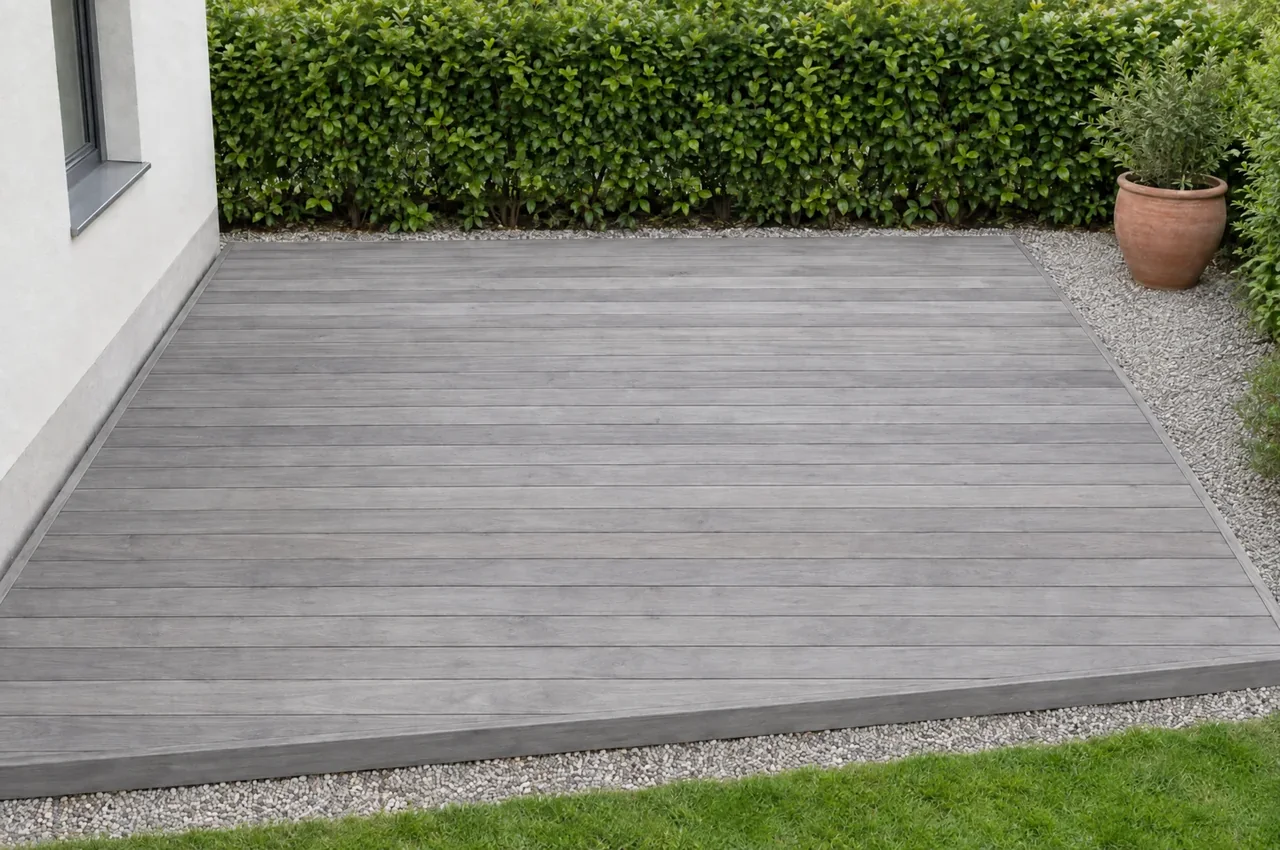
The same small deck shown with a gray surface appearance.
Illustrative ownership context. Appearance is not a service-life prediction; costs and replacement events come from the scenario inputs.Use two records
A DIY plan can require little paid labor while consuming substantial owner time. Record cash purchases in one column and your expected hours in another. Include the activities you actually expect to perform, such as arranging supplies, preparing for work, completing it, and cleanup. These are planning categories rather than technical instructions. If more than one household member participates, record combined hours and identify the assumption. Keeping the records separate lets a reader understand both the household spending and the effort behind it.
Describe how you value the hours
You may choose an hourly value for your time, but that value is a personal scenario input. It is not a wage quote, a guaranteed lost earning, or money that leaves your account. A separate economic comparison can multiply hours by your chosen value. Label that result clearly and retain the cash-only version. Do not add both a paid contractor charge and owner labor for the same work unless both really belong in the stated scope.
Use the compact calculator carefully
The home studio records initial owner hours and hours for each event, with an undiscounted labor total separate from cash. The two-plan scenario planner models cash costs; keep hours in a companion record when using that tool. If you create another run that includes a chosen value for time, name it as an effort-valued scenario and document the arithmetic. Apply the same convention to both alternatives. Remember that available weekends, enjoyment of the work, and willingness to organize service can matter even when the cost ranking stays unchanged.
Hypothetical personal-time valuation
An owner assumes $120 of annual supplies and six annual hours. At a personally selected $25 per hour, the added time value is $150, making an effort-valued annual amount of $270. Cash spending remains $120. Over five years, the record shows $600 cash and thirty owner hours before any separate event. These figures are invented planning inputs.
Common questions
Should I use my salary as the hourly value?
You can choose a value that helps your decision, but explain it. Salary is not automatically the cost of a leisure hour or a realizable loss of earnings.
What if I enjoy doing the care?
Keep the hours visible and note your preference. You do not have to assign a dollar penalty to time you enjoy spending.
Evidence & limits
Reviewed September 13, 2026. Sources support their stated technical principles; this site's workflows and hypothetical examples are not product tests, supplier approvals or independently reviewed project records.