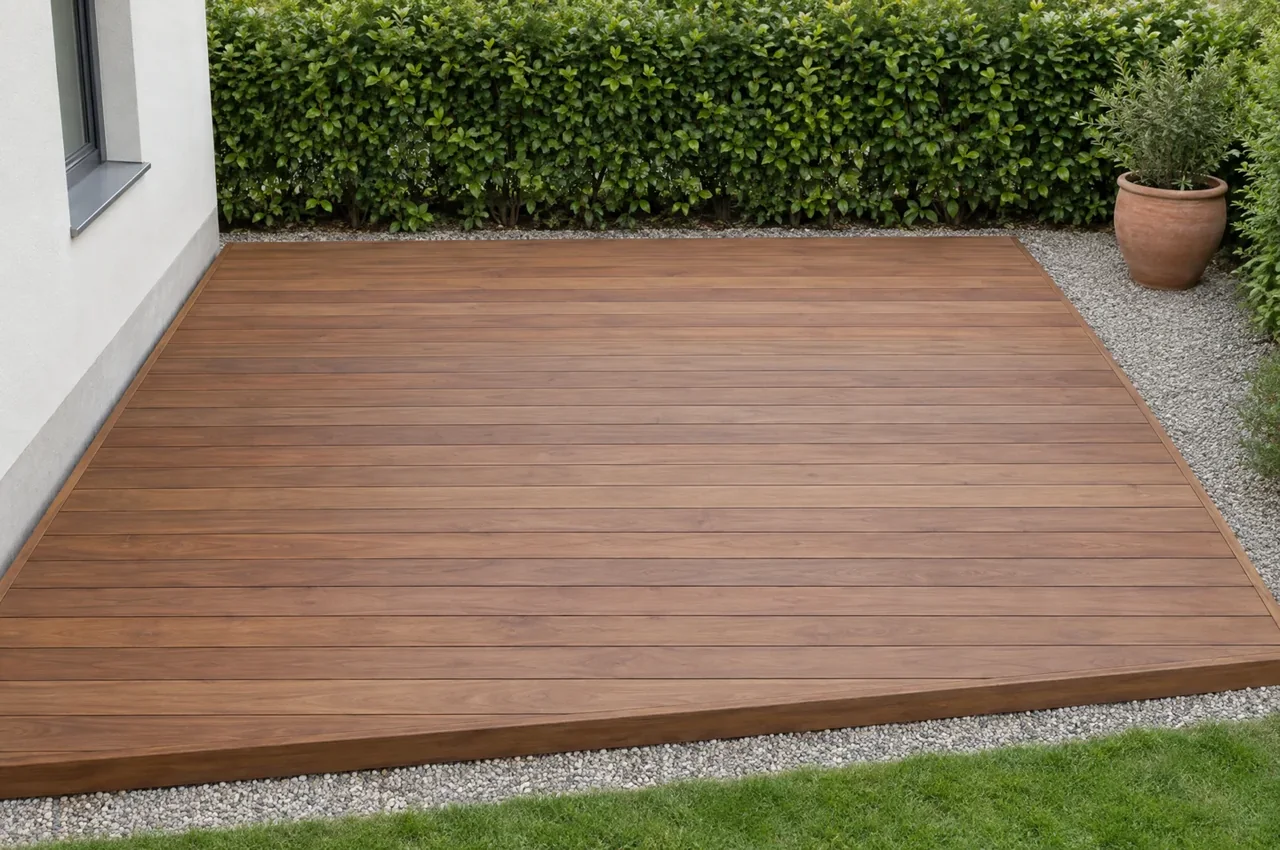
A small brown deck between a house, a hedge and a gravel border.
Illustrative ownership context. Appearance is not a service-life prediction; costs and replacement events come from the scenario inputs.Define what is shared
Name both scenarios so you can identify their sources and assumptions later. Before comparing money, check whether each covers the same usable project, included services, and ownership period. Write down any deliberate differences. A plan with paid care and a plan with owner care may be a useful comparison, but the difference includes labor responsibility as well as cash. A lower total alone does not explain why it is lower. Keep preference notes beside the cost analysis instead of turning them into unsupported monetary benefits.
Change only the inputs that differ
Use the same horizon, dollar basis, and discount-rate convention for both sides. If an annual allowance is identical, leave it identical rather than adjusting it to make the scenario feel different. Reconcile initial-cost inclusions and separate future events from annual amounts. The two-plan planner supports annual allowances, additional dated events and recurring replacement. The home studio supports separate recurring or one-time events with cash and hours. Use the same level of schedule detail for each alternative and document any simplification.
Explain the difference in plain language
After running the comparison, identify whether the difference comes mainly from the initial commitment, recurring spending, or the timed event. Check both undiscounted and discounted totals using the same assumptions. Then change the most uncertain input and see whether the ranking persists. Avoid declaring a material or brand universally cheaper from one personal scenario. A useful conclusion states the horizon, the main assumptions, and what would have to change to alter the result.
Keep the scope equal before comparing the totals
A cheaper scenario is not necessarily a cheaper way to obtain the same result. Check that both cases describe the same deck area, included structure, initial installation scope, ownership period and appearance expectation. A natural-weathering care plan and a maintained-colour plan can be compared, but the different owner objectives should be explicit.
Suppose scenario A includes surface removal, disposal, new boards and installation while scenario B contains only the new boards. Their replacement totals are not comparable. Add the omitted work or label the difference before interpreting the cost chart. Do the same for access, site protection and any excluded framing work.
Change one uncertain assumption at a time when investigating a result. For example, compare the same two scopes with an earlier and later user-selected replacement event. The change shows sensitivity to that assumption; it does not establish the material’s actual service life.
A comparison review before drawing a conclusion
| Basis | Question |
|---|---|
| Quantity | Do both cases use the same area and assembly scope? |
| Care objective | Natural appearance or maintained colour? |
| Replacement | Are teardown, disposal, materials and labour included consistently? |
| Money | Same currency, price basis and discount convention? |
| Time | Same study horizon and event timing rules? |
| Output | Cash, present value and labour hours distinguished? |
Save the assumptions with the result. If a total changes after a quote or schedule update, a reader should be able to identify the changed input rather than attributing the movement to the material name alone.
Hypothetical equal-scope comparison
Scenario A has $10,000 initially and $400 annually. Scenario B has $11,500 initially and $200 annually. Neither includes a timed event. Over ten years, undiscounted totals are $14,000 and $13,500. B is $500 lower on that measure, despite costing $1,500 more initially. The result depends entirely on these invented annual differences.
Common questions
Can I compare a DIY plan with a paid-service plan?
Yes, if you identify the different labor responsibilities and track owner hours separately. Do not describe the resulting cash difference as equal-effort savings.
What should I do when totals are close?
Review uncertain inputs and scope first. A small modeled difference may be less useful than getting a clearer quote or understanding the effort each scenario requires.
Evidence & limits
Reviewed September 13, 2026. Sources support their stated technical principles; this site's workflows and hypothetical examples are not product tests, supplier approvals or independently reviewed project records.