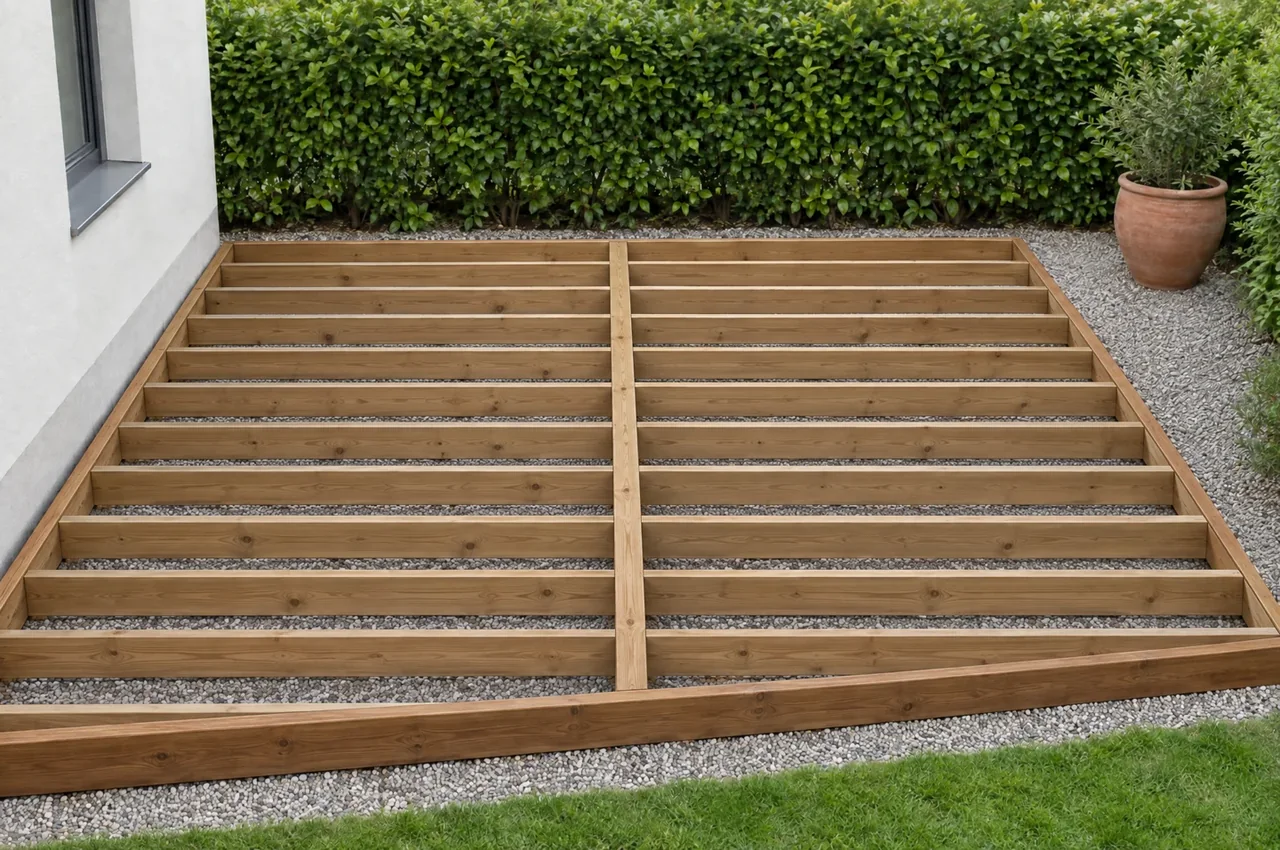
A deck context with the walking boards removed to expose a framing concept.
Illustrative ownership context. Appearance is not a service-life prediction; costs and replacement events come from the scenario inputs.Save a baseline before experimenting
Record both scenarios, their horizon, and the real discount rate before changing an input. Include the date and source notes. A baseline gives each experiment a clear reference point. Without one, it is easy to compare a result from a shorter period with another that also uses a different annual allowance and event year. The purpose of sensitivity testing is to learn which assumption matters, not to accumulate many unlabeled totals.
Vary one uncertain input at a time
Start with an input you genuinely do not know well: perhaps an annual allowance, an event amount, or the ownership period. Choose lower and higher values that you can explain. Keep all other settings fixed and note the change in each scenario's total and ranking. The two-plan planner shows automatic ±20% sensitivity ranges for initial and annual costs, plus a proportional range for all costs and residual assumptions together. For other inputs or the home studio, make separate runs and record the changed assumptions. If two assumptions logically move together, test them as an explicitly named combined case after examining the individual effects.
Use the result to guide the next question
If a small change reverses the comparison, better evidence for that input may be more valuable than extra decimal precision. If a wide range leaves the result similar, focus attention elsewhere while keeping the limits of your chosen range visible. A range is not a probability forecast. Do not say that a scenario is ninety percent likely to win because it won most of a few handpicked runs. Report the tested conditions and the conditions you did not examine.
Find the assumptions large enough to matter
More decimal places do not make an ownership model more certain. Start by identifying inputs with both substantial uncertainty and a meaningful effect on the result: initial installed cost, finish frequency, owner hours, replacement scope, event timing and discount rate. An unresolved $12,000 event may matter more than refining a minor annual allowance by a few dollars.
Keep one base scenario and make clearly named copies. Change one input at a time first. This reveals the direction and size of its effect. Then combine related changes where that combination describes a plausible ownership situation. Do not describe a combined result as the effect of a single variable.
Use a small comparison that can be read without a chart
Suppose two hypothetical scenarios differ by $2,000 in initial installed cost. In a simple undiscounted comparison, an assumed annual care difference of $100 accumulates to $2,000 after 20 scheduled annual events. A difference of $50 requires 40 such events. This arithmetic ignores replacement, inflation, discounting and other costs, so it cannot establish a real break-even date. It demonstrates why a care allowance deserves scrutiny when it drives the conclusion.
| Test | Hold fixed | Change |
|---|---|---|
| Installation sensitivity | Care and replacement schedule | Initial quoted total |
| Appearance sensitivity | Same deck and material | Finish-related tasks and hours |
| Replacement sensitivity | Other ownership inputs | Event scope, cost or timing |
| Economic sensitivity | Same dated cash events | Discount rate and consistent dollar basis |
For a timing test, move the same event to another selected model year without silently changing its scope. For a scope test, compare surface-only replacement with the explicitly defined wider rebuild. Those are two separate uncertainties and should have separate labels.
Recognize a result that is too close to call
If modest, plausible changes reverse the ranking, the model has identified a close decision. Report which inputs cause the reversal. The next useful action may be obtaining a firmer installation quote, reviewing the appearance commitment or clarifying the replacement scope. Selecting a single favorable set of assumptions would hide the most useful finding.
An uncertainty range entered by the user is not a probability distribution. The lowest and highest results are scenario endpoints, not confidence limits, guaranteed minimums or maximum possible costs. Do not assign likelihoods unless there is a defensible basis for them. A scenario can be informative without pretending to predict the future.
Compare money with the owner's actual priorities
Some differences do not reduce neatly to a cost: the willingness to perform recurring work, acceptable appearance changes, disruption during a rebuild or the ability to arrange access. Keep those considerations beside the financial comparison. The least expensive modeled case may involve a workload the owner will not realistically undertake.
Use equal-scope scenario comparison before interpreting the ranking. General sensitivity and life-cycle methodology are described in NIST Handbook 135. The deck scenarios remain user-defined and do not establish species lifespans, future market prices or guaranteed savings.
Hypothetical annual-cost threshold
A costs $10,000 initially and $300 annually. B costs $11,000 initially. With no events and a ten-year horizon at zero percent, B matches A if its annual amount is $200. At $150 it is lower; at $250 it is higher. These three hypothetical runs identify the annual assumption worth examining more closely.
Common questions
How many runs are enough?
Use enough to answer the specific uncertainty. A baseline plus a clear lower and higher case often reveals the next useful question without creating a large unreadable table.
Should I change the rate too?
You can test different real rates within the supported range. Record them as separate experiments so their effect is not confused with changed cost assumptions.
Evidence & limits
Reviewed September 13, 2026. Sources support their stated technical principles; this site's workflows and hypothetical examples are not product tests, supplier approvals or independently reviewed project records.