Work through a complete example
These scenarios demonstrate methods. The numbers and scenes are illustrative, not documented customer projects, current prices or verified material results.
Hypothetical ten-year baseline
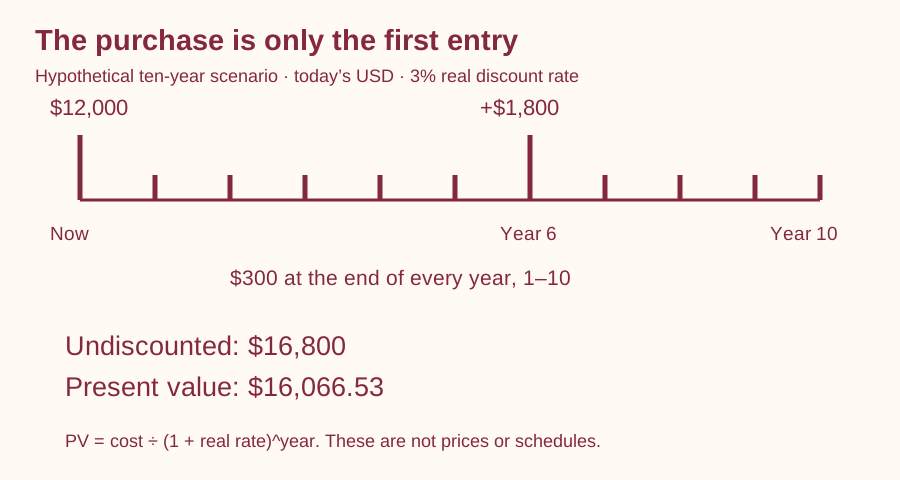
An owner enters $12,000 initially, $300 at each year end for ten years, and $1,800 at the end of year six. The undiscounted total is $16,800 in today's dollars. At a three percent real rate, present value is $16,066.53. These invented amounts demonstrate timing; they are neither prices nor a recommended maintenance schedule.
Read the method: Start with the ownership questionHypothetical overlap caught early
Suppose a $9,000 project quote already includes a $250 delivery charge. Adding delivery again would incorrectly make initial cost $9,250. An owner checks the quote and enters $9,000. Separately, the owner assigns a hypothetical $180 annual care allowance and a $900 event in year five. None of these figures is a market estimate.
Read the method: Build a cost inventory you can traceHypothetical annual allowance and separate event
An owner models $200 annually for eight years and an additional $1,000 event in year four. Future undiscounted spending is $2,600. If the $200 annual allowance already contained a share of that event, the model would double count it. The owner documents that the two allowances cover different work. These dates describe an invented scenario, not recommended intervals.
Read the method: Building a deck maintenance cost schedule