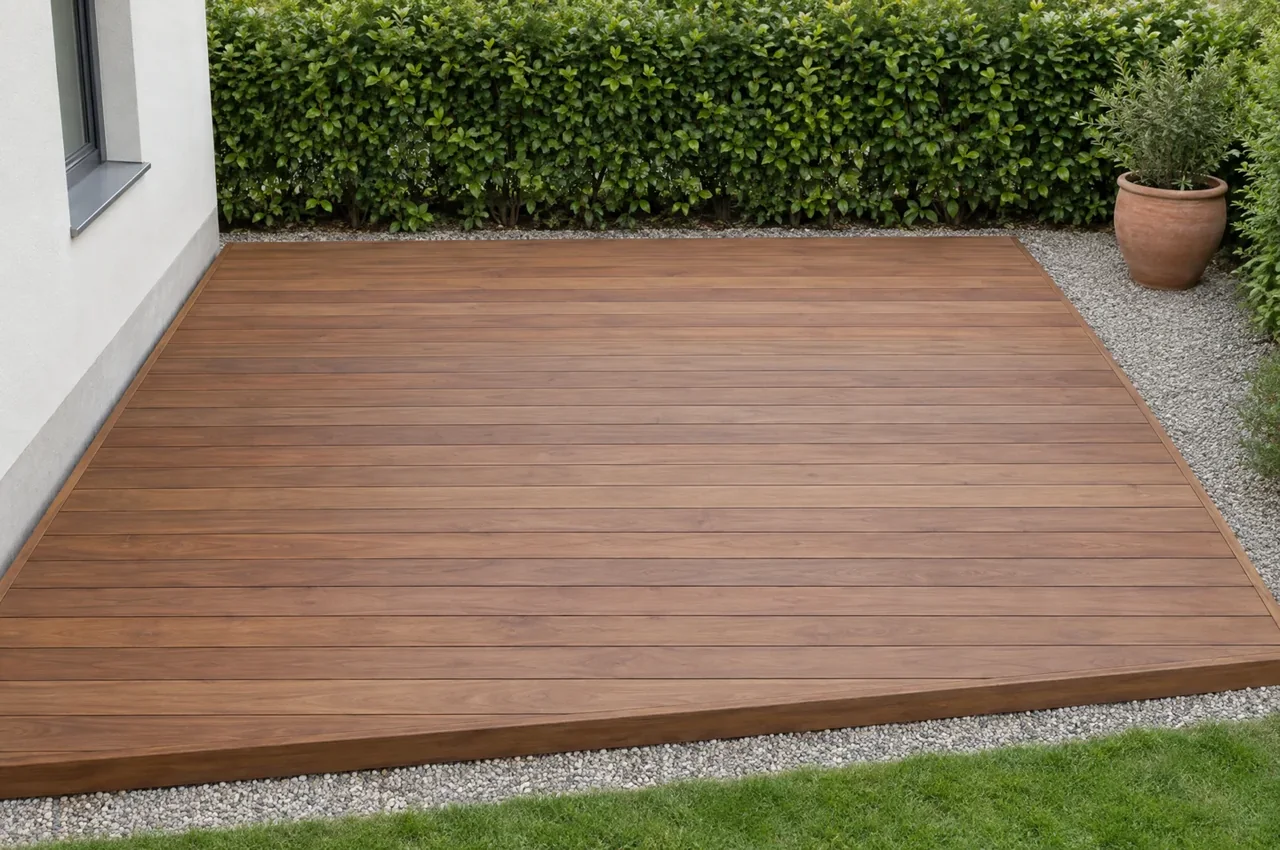
A small brown deck between a house, a hedge and a gravel border.
Illustrative ownership context. Appearance is not a service-life prediction; costs and replacement events come from the scenario inputs.Write a decision sentence
Start with one sentence that identifies the decision, the owner, and the period being considered. For example: compare two quoted projects over the next ten years while paying for routine care yourself. A clear question keeps optional upgrades, unrelated yard work, and assumptions about a future buyer from drifting into the calculation. Describe the deck area and included project scope alongside the sentence. Otherwise, a cheaper total may simply represent less work. Keep comfort, appearance, and use preferences in a separate note so a dollar comparison does not silently decide those questions.
Separate the three input groups
The home studio compares material plans with initial costs, cash and labor for scheduled events, and an optional residual credit. The two-plan scenario planner also supports annual allowances, additional dated events and recurring replacement. Initial cost occurs at time zero. Annual spending occurs at the end of every modeled year, and the timed event occurs at its selected year end. All amounts come from you. Build a short inventory before entering them, with a receipt, quote, or clearly labeled allowance behind each number. Enter irregular work as separate scheduled events. Both tools use whole years and year-end future costs; preserve exact payment dates in your supporting records.
Read the result as a scenario
Choose an ownership horizon from one to sixty years and a real discount rate from zero to twenty percent. Enter amounts in today's dollars. The resulting comparison describes those assumptions, not a material lifespan, a promised bill, or a resale return. Record which expenses are excluded and whether unpaid owner time appears elsewhere. A useful first result is a transparent baseline that you can revise. Avoid polishing uncertain inputs to the nearest dollar merely because the output displays cents.
Hypothetical ten-year baseline
An owner enters $12,000 initially, $300 at each year end for ten years, and $1,800 at the end of year six. The undiscounted total is $16,800 in today's dollars. At a three percent real rate, present value is $16,066.53. These invented amounts demonstrate timing; they are neither prices nor a recommended maintenance schedule.
Common questions
Does a lower total identify the best deck?
It identifies the lower modeled cost for the stated scope and assumptions. Appearance, suitability, effort, and actual project requirements still need their own assessment.
Should I subtract an expected resale gain?
Both tools accept an optional residual credit at the horizon but do not estimate resale proceeds. Keep the credit at zero unless you have a documented basis, and test the comparison without it.
Evidence & limits
Reviewed September 13, 2026. Sources support their stated technical principles; this site's workflows and hypothetical examples are not product tests, supplier approvals or independently reviewed project records.