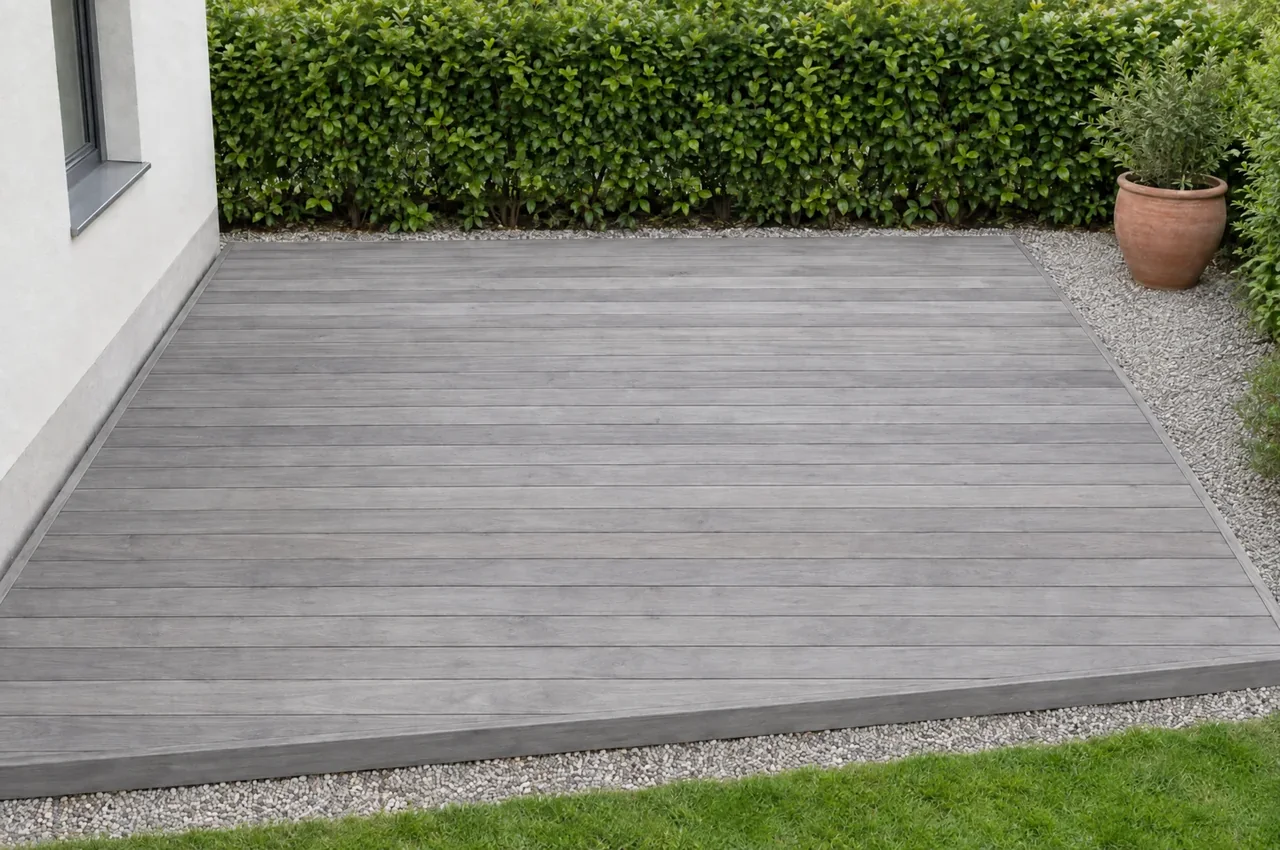
The same small deck shown with a gray surface appearance.
Illustrative ownership context. Appearance is not a service-life prediction; costs and replacement events come from the scenario inputs.Tie the horizon to your decision
The horizon is the number of years included in the comparison. It can reflect how long you want to study ownership spending or a period useful for comparing two plans. It is not a declaration of material life. Write the reason for your selection in a sentence. If your plans are uncertain, choose a baseline and test another plausible period. The tool accepts one through sixty years, but availability of a long period is not evidence that any project will last that long.
Watch what crosses the boundary
Initial spending stays in every run, while annual amounts accumulate across the selected years. A timed event belongs in the total only when its year falls within the period. Changing the horizon can therefore change the ranking sharply around an event. Inspect that boundary rather than reporting only the favorable run. When an event sits just beyond the selected horizon, mention it in the decision record. Exclusion from a limited analysis does not mean the owner will never face the cost.
Avoid inventing an ending benefit
Both tools allow an optional residual credit at the horizon; neither estimates that value for you. Do not subtract an unsupported percentage of the initial project because you expect some value to remain at the end. A real transaction or separately supported appraisal question would require its own analysis. The horizon is the cutoff for modeled expenses and the point at which any entered residual credit is applied. Keep usage and nonfinancial preferences visible as separate considerations. The goal is to understand spending across the period you selected, not to manufacture a complete property-investment return.
Hypothetical boundary effect
A scenario has $8,000 initially, $250 annually, and a $1,200 event in year nine. Over eight years its undiscounted total is $10,000. Over ten years it is $11,700. The $1,700 increase includes two more annual amounts plus the event. It does not imply that the project stopped working after either horizon.
Common questions
Should both scenarios use the same horizon?
Yes, for a direct comparison in this tool. Different periods can create differences that come from the analysis boundary rather than the plans themselves.
What if I may move earlier?
Run a shorter and longer ownership scenario and record the uncertainty. This tool does not estimate sale proceeds or the effect of a deck on a home's sale price.
Evidence & limits
Reviewed September 13, 2026. Sources support their stated technical principles; this site's workflows and hypothetical examples are not product tests, supplier approvals or independently reviewed project records.