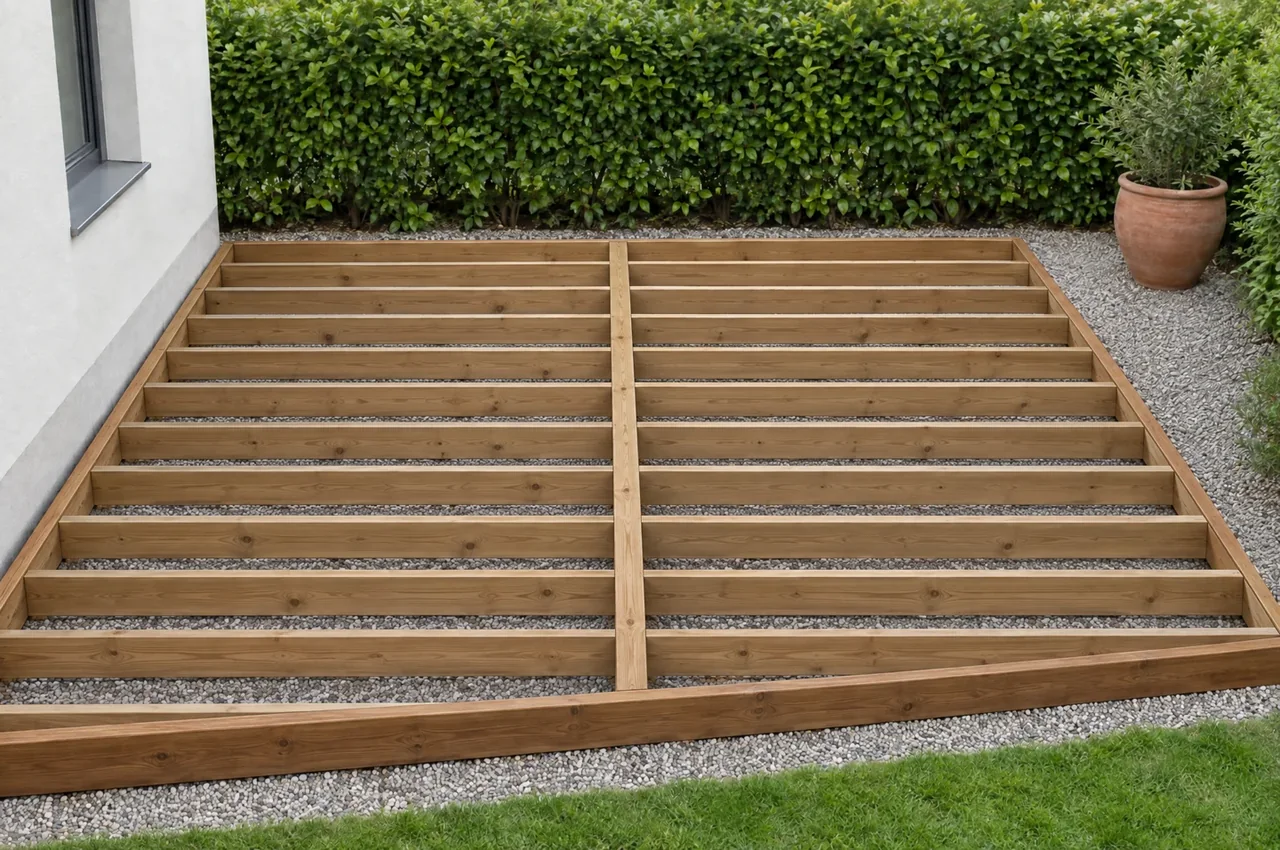
A deck context with the walking boards removed to expose a framing concept.
Illustrative ownership context. Appearance is not a service-life prediction; costs and replacement events come from the scenario inputs.Describe the event before pricing it
A future-event allowance needs a clear scope. State what you are assuming will be repaired or replaced, whether the amount includes paid labor and related services, and why you selected its timing. This is a planning exercise, not a diagnosis. A generic replacement label can conceal very different work between scenarios. If the event is only a possibility, say so explicitly rather than writing as if the work is certain to occur on that date.
Test uncertainty without pretending to predict
You can explore an earlier event, a later event, or a different allowance in separate runs. Hold the other inputs fixed so you can see the effect of the change. Do not assign a failure probability unless you have a defensible basis and a model capable of using it; this calculator does not compute expected values or probability distributions. A lower discounted result from a later year is a mathematical timing effect. It does not establish that delaying real work is appropriate.
Keep the full event sequence visible
Both tools support multiple scheduled events. Enter distinct repairs, partial replacements or removal allowances separately, using dated events in the two-plan planner or event rows in the home studio. Combining them at one date changes timing. Also check the horizon: an event beyond the selected period is outside that analysis, not eliminated from reality. Do not move a replacement just outside the horizon to produce a favorable total. Explain why both the event year and the horizon are reasonable for your question.
Define what the replacement actually replaces
Replacing several damaged boards, replacing the entire walking surface and rebuilding the whole deck are different events. The first may retain nearly all of the assembly. The second may retain framing only after its condition and suitability have been assessed. The third includes a wider construction scope. Name the event in the model so a future reader knows which one the cost represents.
A material-only allowance understates a replacement event when the owner also expects to pay for removal, disposal, delivery and installation. Break the event into those lines even when the contractor ultimately quotes a lump sum. The breakdown lets you see which costs are known, which are provisional and which have been excluded. Reusing a railing or framing member should remain a scoped assumption, not an automatic credit.
Build a complete event from a fictional quote
The following example shows how a $12,000 event might be assembled. It is not a price estimate for a particular deck, location or material. The point is that the visible jump on the ownership timeline needs a complete, traceable scope.
| Event component | Illustrative amount | Scope question |
|---|---|---|
| Teardown labor | $1,800 | What is being removed and retained? |
| Disposal and hauling | $900 | Which material and access conditions are included? |
| New decking and specified accessories | $4,200 | Does the quantity match the replacement scope? |
| Rebuild labor | $4,500 | Which preparation and installation work is included? |
| Delivery and receiving | $600 | Is unloading part of the quoted service? |
| Total modeled event | $12,000 | Are taxes and other exclusions addressed separately? |
If a contractor's rebuild line already includes removal, do not add teardown again. If new fasteners are included in the material package, do not duplicate them as an accessory allowance. Conversely, do not omit an entire category because no quote has arrived. Mark it unresolved and test a clearly labeled planning allowance until the scope is priced.
Treat the event date as a scenario input
The timeline can place a possible replacement at a selected inspection year. That date is an assumption about the modeled event, not the predicted failure date of a species. Appearance, structural condition, changes in use and the owner's preferences can lead to different interventions. A supplier-reported service-life statement cannot establish the exact year at which this particular deck will require work.
Test an earlier event, a later event and a case without that event inside the study horizon. If the ownership ranking changes substantially, replacement timing is a major uncertainty. Show that uncertainty with the competing results rather than selecting the date that favors a preferred material. A study extending up to 75 years is a planning window; it does not certify up to 75 years of service for every component.
Reconcile the care schedule after the event
A replacement surface starts a new care history. Review any finish, repair or cleaning events already scheduled for the same period. Some work may be part of the replacement contract; some may still be necessary afterward. Avoid charging for a major finish renewal immediately before a full surface replacement unless that sequence reflects a deliberate owner decision.
The cost-inventory guide helps retain the source for each line. NIST Handbook 135 provides the general framework for comparing investment, operation, maintenance and replacement costs over a common study period. It is not a deck-life table or a source for these fictional prices.
Hypothetical event-year sensitivity
An owner tests a $2,000 event in year four, then repeats the scenario with that event in year eight. At a zero percent rate, both contribute $2,000 to the total. At a positive real rate, the later event has a lower present value. The comparison makes no claim about when a deck component will need replacement.
Common questions
Does entering year twelve mean a twelve-year lifespan?
No. It records an assumed event date for that scenario. A lifespan claim requires evidence beyond a calculator input.
Can I use zero for the event amount?
Yes, when the scenario intentionally includes no timed-event allowance. Document that assumption so it is not mistaken for proof that no future work will occur.
Evidence & limits
Reviewed September 13, 2026. Sources support their stated technical principles; this site's workflows and hypothetical examples are not product tests, supplier approvals or independently reviewed project records.