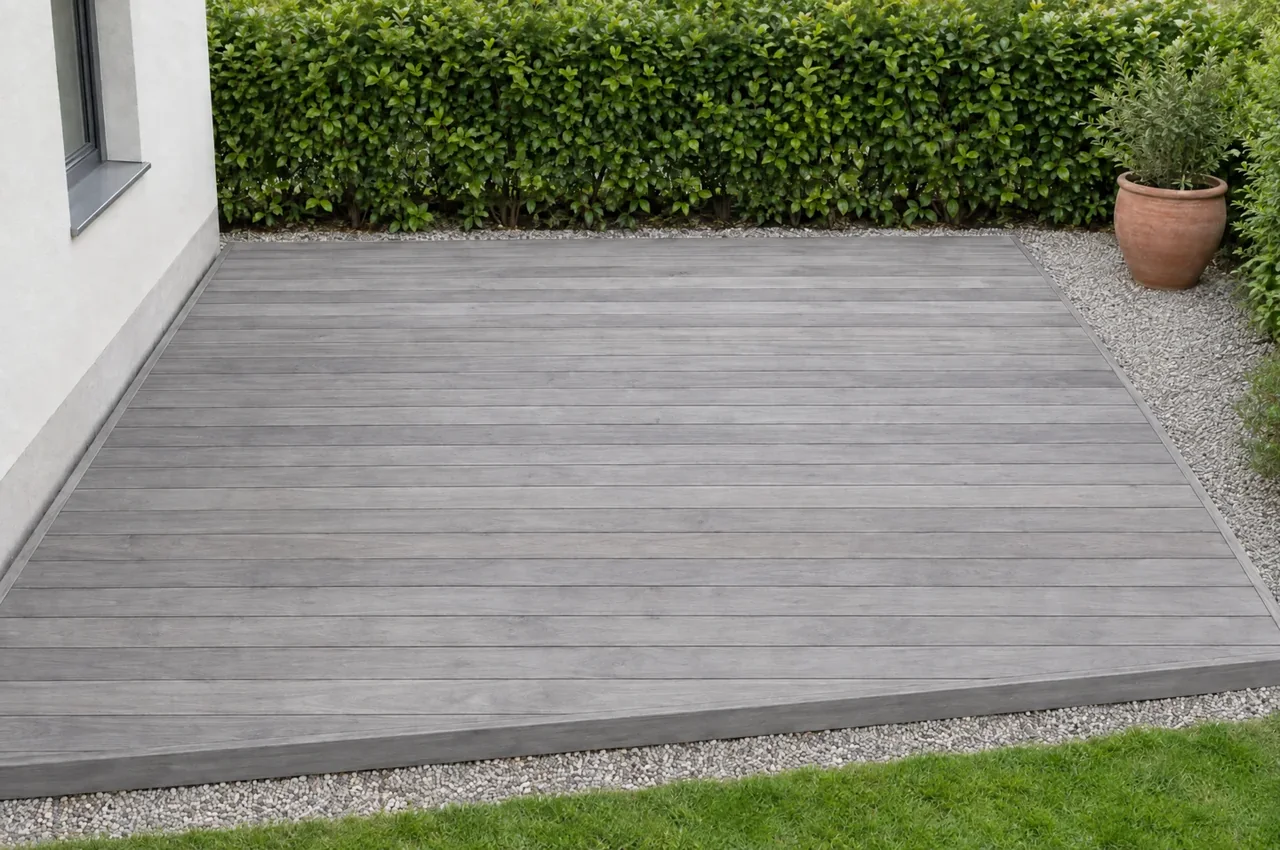
The same small deck shown with a gray surface appearance.
Illustrative ownership context. Appearance is not a service-life prediction; costs and replacement events come from the scenario inputs.Start with your evidence
Collect the care guidance relevant to the products and conditions of your project, together with actual service records and any written scope from a provider. Use those records to inform your own planning assumptions. This guide does not prescribe a treatment interval or predict when a deck will need work. Write each assumed activity in plain language, including what the allowance covers. A label such as care is too broad if one scenario includes supplies and labor while another includes supplies alone.
Distinguish an annual pattern from a dated event
An annual field repeats the same amount at every year end in the selected horizon. It does not create a custom calendar or skip years. Use it when a constant annual allowance is a suitable simplification for your question. A separate event field places one amount in one year. Do not include that same expense in both fields. For work in uneven years, enter additional dated events in the two-plan planner or one-time events in the home studio. Preserve exact dates separately because both tools use whole-year timing.
Review the schedule when circumstances change
A schedule is a record of assumptions, not an instruction to perform work automatically. Update it when the scope of a quote changes, your ownership plans change, or a completed event provides better cost information. Keep the previous version so you can see whether the difference came from amount, timing, or scope. When uncertainty concerns timing, compare an earlier and a later event year while holding the other inputs fixed. Do not infer that postponing needed work is beneficial just because it reduces present value.
Write the work before selecting its interval
A maintenance event should describe a task someone can recognize: inspect and clean a defined surface, renew a specified finish, replace a limited group of boards, or perform a larger repair. A row called maintenance with one recurring charge hides too much. It leaves the reader unable to tell whether labor, materials and access work have been included.
For each task, record the area or quantity involved, hired cost, owner hours, material cost and trigger. The trigger may be a planned interval for budgeting or a condition requiring review. A budgeting interval does not override product instructions or actual observed condition. The model shows the consequences of the schedule you enter; it does not inspect the deck.
Separate appearance choices from necessary attention
Choosing natural weathering for Ipe removes a maintained-color objective from the scenario. It does not eliminate inspection, cleaning as appropriate, or the possibility of repair. A color-maintenance scenario adds the preparation and finish work associated with that appearance goal. Keep the two schedules distinct so the owner can see the workload attributable to the chosen finish strategy.
Likewise, a manufactured decking product should use its own documented care requirements. Do not give it zero care merely because a brochure uses a low-maintenance description. Cleaning, inspection and any other modeled tasks should be named and scoped. The ownership model should compare actual assumptions rather than slogans.
Check how recurring events land inside the horizon
Suppose a fictional schedule places one task every third model year after installation. Inside a horizon ending at model year 10, it occurs at 3, 6 and 9: three events. A horizon ending at 9 also includes three if the model includes events at the endpoint. A horizon ending just before 9 includes two. Record the endpoint convention so repeated calculations remain comparable.
| Schedule field | Example of a useful entry | Ambiguous entry |
|---|---|---|
| Work | Inspect and clean the main walking surface | General upkeep |
| Cost basis | Dated quote or explicit owner allowance | Typical cost |
| Owner time | Entered hours for setup, work and cleanup | Free labor |
| Trigger | Assumed recurrence, reviewed against condition | Always required at this age |
| Reset | Review after surface replacement | Continue every old event unchanged |
Account for work that happens together
A cleaning task may be part of finish preparation. A repair visit may include an inspection. If two rows charge for the same work on the same visit, adjust their scopes rather than deleting either category blindly. The event list should show whether a bundled contractor price includes materials, labor and preparation.
When replacement occurs, review the recurring schedule from that point. Reusing an old finish calendar can create events that no longer correspond to the installed surface. Keep the original assumption available for comparison, then identify the changed schedule as a new scenario.
Replace assumptions with ownership records
Record actual dates, areas, hours and paid amounts after work occurs. Keep the difference between planned and actual work visible. One unusually difficult season should not automatically establish a permanent interval, but it can reveal missing scope or an unrealistic labor allowance.
This scheduling method is an original deck-ownership workflow. Use the DIY time guide when the owner performs the work and the ownership record to retain what happened. Detailed cleaning or application instructions belong to the selected product's instructions and the specific maintenance task.
Hypothetical annual allowance and separate event
An owner models $200 annually for eight years and an additional $1,000 event in year four. Future undiscounted spending is $2,600. If the $200 annual allowance already contained a share of that event, the model would double count it. The owner documents that the two allowances cover different work. These dates describe an invented scenario, not recommended intervals.
Common questions
Can the tool repeat an event every third year?
Yes. In the home studio, set an event's recurrence to three years; use a care-frequency factor of 1 to preserve that interval for care and finish events. The two-plan planner supports recurring replacement and additional dated events. Inspect the resulting years in the ledger.
Does averaging irregular work preserve the comparison?
It may preserve an undiscounted sum over a chosen period, but usually changes payment timing and discounted value. Label the average as an approximation.
Evidence & limits
Reviewed September 13, 2026. Sources support their stated technical principles; this site's workflows and hypothetical examples are not product tests, supplier approvals or independently reviewed project records.