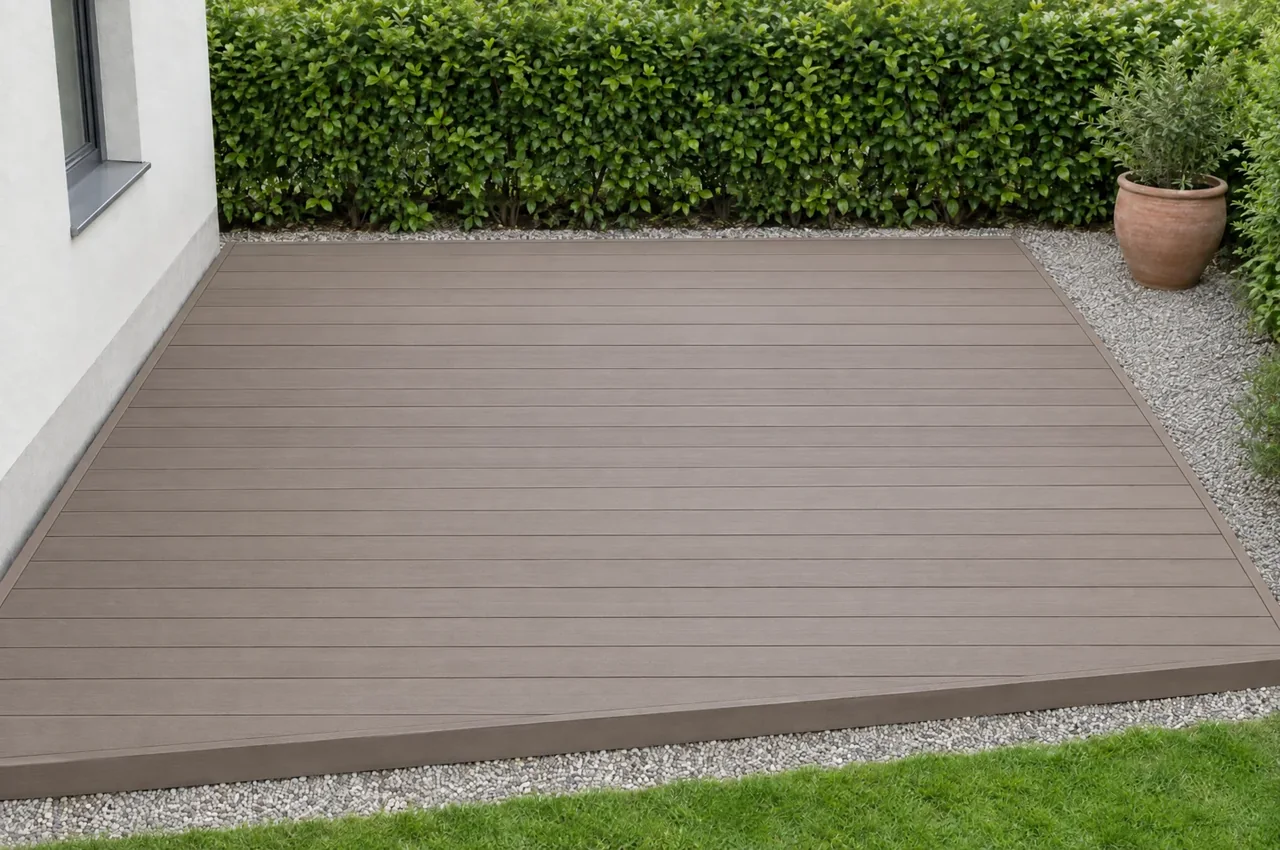
A small deck shown with uniform gray board surfaces.
Illustrative ownership context. Appearance is not a service-life prediction; costs and replacement events come from the scenario inputs.Identify the product generation
Save the product identifier, collection, color, profile, and purchase date. Composite is too broad a label for a useful care allowance. USDA's composite chapter describes a varied material category; its general discussion does not establish the performance or cleaning requirements of a particular deck board. Obtain the care document supplied for the actual product before estimating effort or hiring service. Include the quoted project scope consistently: comparing surface boards alone with a complete finished project misstates the initial difference before any ownership calculation begins.
Translate cleaning guidance into a budget scope
Build a cleaning allowance from the supplies or service you expect to use and document who handles the work. Ask whether the service covers ordinary debris, a specific stain, or a separate restoration task. Those are scope questions, not claims that all composites need identical treatment. A marketed reduction in maintenance does not provide a household dollar figure. Keep rails and other surfaces visible because one allowance may not cover every component. Save the source note and revise it when the intended service changes.
Treat damage response as a separate question
Do not presume a wood refinishing method is suitable for a manufactured surface. For planning, ask what a repair or replacement service would include for the stated issue. Record access, replacement material, labor, and removal rather than assigning a generic repair percentage. Enter additional dated events when you want to examine several distinct jobs and use the ledger to check their sequence. Review warranty scope separately. An uncertain reimbursement should not become an automatic credit, and a warranty term is not a verified service-life prediction.
Hypothetical composite cleaning sensitivity
A scenario enters $15,000 initially, $150 annually, and a $900 event in year nine. Its ten-year undiscounted total is $17,400. If the owner instead uses a hypothetical $350 annual paid-cleaning allowance, the total is $19,400. The $2,000 difference reflects the chosen service arrangement; it is not a material price comparison or a forecast of damage.
Common questions
Can I enter zero annual care because no stain is planned?
Only if zero accurately describes your deliberate spending assumption. Record cleaning responsibilities and unpaid hours so the result remains interpretable.
Should all composite collections share one repair allowance?
No. Ask about the actual product, issue, and replacement scope. A material-family label does not define how a service provider will address damage.
Evidence & limits
- USDA Wood Handbook, Chapter 11 — composite-material background, not product cleaning or lifespan claims
- NIST Handbook 135, 2025 — cost-method reference, not material performance or prices
Reviewed September 13, 2026. Sources support their stated technical principles; this site's workflows and hypothetical examples are not product tests, supplier approvals or independently reviewed project records.