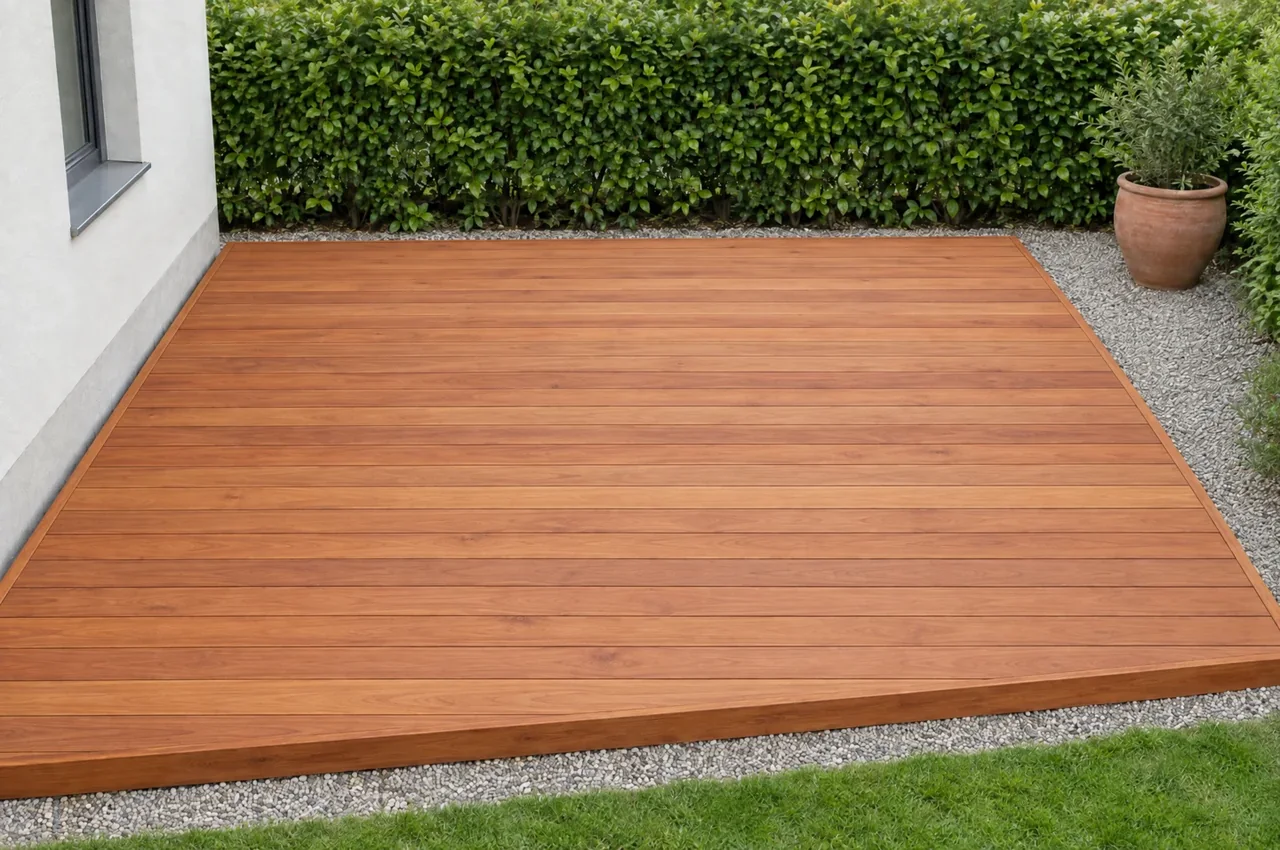
A small deck shown with warm reddish board surfaces.
Illustrative ownership context. Appearance is not a service-life prediction; costs and replacement events come from the scenario inputs.Identify the quoted product and finish
Pressure-treated wood is a broad purchasing description. Record the actual product, quoted grade and dimensions, and whether the initial scope includes a finish. USDA's Wood Handbook distinguishes preservative protection from surface finishing. The ownership implication is to document both rather than assume treatment answers every care question. Keep the care instructions supplied with your project in your own records. For cost planning, ask the provider to separate the initial project from future services so you can see what you are committing to. No generic material label supplies a dependable annual dollar amount.
Build the annual allowance from tasks
List cleaning supplies or service, the chosen finish-care plan, and owner hours. Decide whether the annual number represents annual spending or an averaged allowance. For irregular finishing work, dated events preserve the timing of larger expenses. Keep an event out of the annual figure if it is already entered separately. Use recurring replacements only for an explicitly stated replacement assumption. Review the event ledger to catch overlap, and attach source notes explaining the scope behind each amount. Your documents should determine the inputs; there is no universal treated-wood budget here.
Price a defined repair scope
A possible board replacement is different from rebuilding the entire deck. If you test an event, specify what is included: affected surface area, labor, compatible replacement material, removal, and any associated finish work. Ask for a scoped estimate instead of multiplying initial cost by an arbitrary repair percentage. Keep the supporting structure and railing in the overall inventory even when the surface material is the focus. Do not assign a replacement year merely because the comparison horizon ends then. The event year is your assumption, not a verified lifespan.
Hypothetical ten-year treated-wood plan
An owner enters $9,500 initially, $350 annually for ten years, and a $1,200 board-work allowance in year seven. At zero percent, the total is $14,200. Raising only the annual allowance to $450 makes it $15,200. The $1,000 difference shows why documenting care scope matters. Every amount and date is hypothetical and does not represent a treatment interval or market price.
Common questions
Does treatment remove the need to budget for care?
No. Use the actual product's care guidance and your chosen appearance standard to develop a documented allowance.
Should I automatically replace the deck in year thirty?
No. Thirty years can be a study period. Replacement timing needs a separate stated assumption and supporting project information.
Evidence & limits
- USDA Wood Handbook, Chapter 15 — general preservative treatment principles
- USDA Wood Handbook, Chapter 16 — general wood-finishing principles, not product care schedules
- NIST Handbook 135, 2025 — cost-method reference, not material performance or prices
Reviewed September 13, 2026. Sources support their stated technical principles; this site's workflows and hypothetical examples are not product tests, supplier approvals or independently reviewed project records.