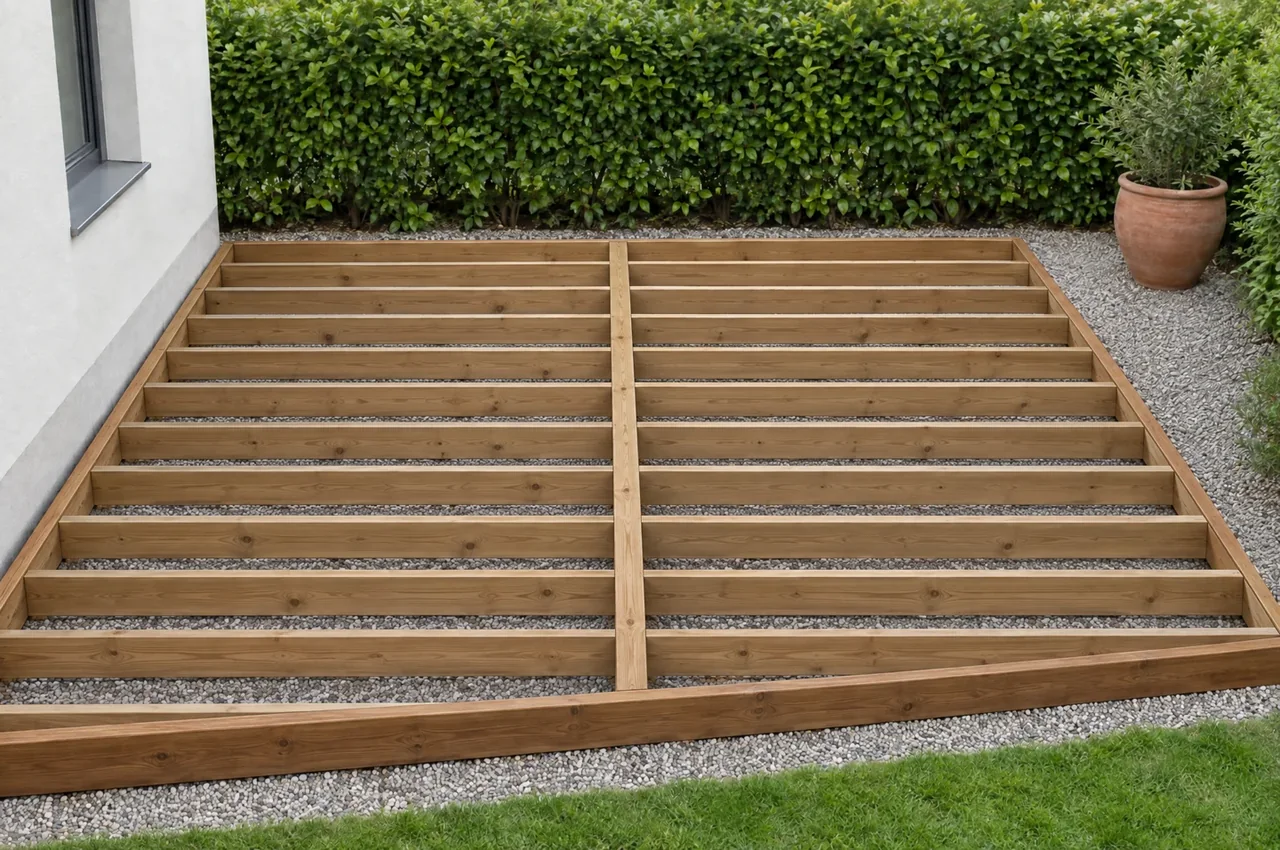
A deck context with the walking boards removed to expose a framing concept.
Illustrative ownership context. Appearance is not a service-life prediction; costs and replacement events come from the scenario inputs.Define a common thirty-year question
Write down why thirty years is useful for the decision, then give both scenarios the same project scope and ownership horizon. Thirty is an analysis boundary, not evidence that either material lasts that long. Record which components the initial quotes include. Choose today's dollars and document the selected real discount rate. The method follows general life-cycle costing principles; it is not a federal-project analysis or a prescription to use any particular government rate for a household decision.
Inventory the entire assumed sequence
List recurring spending and every irregular job you want to study before entering amounts. Use additional dated events for distinct work and recurring replacements for an explicitly assumed repeat sequence. Read the event ledger and markers to verify years, amounts, and events near the horizon boundary. Keep replacement spending out of the annual allowance if already counted in the event schedule. An annualized allowance can simplify an early comparison, but changing payment dates generally changes present value. Explain the approach in the editable source notes.
Inspect the outcome at shorter horizons too
Compare undiscounted and discounted totals, then repeat at shorter periods relevant to your uncertainty. Note which events fall inside each run. Change the least certain annual amount or replacement assumption separately and record whether the ranking changes. Leave residual credit at zero for a baseline; if you use it, document what value it represents and test the comparison without it. Save the scenario so it can be reopened with its assumptions. A useful conclusion names the period and inputs under which one scenario is lower.
Hypothetical thirty-year arithmetic
A has $12,000 initially, $300 annually, and $2,000 in year fifteen. B has $15,000 initially, $150 annually, and $1,000 in year twenty. At zero percent over thirty years, A totals $23,000 and B $20,500. B is $2,500 lower under these invented assumptions. A positive real rate requires discounting each year-end payment; the zero-rate difference cannot simply be reused.
Common questions
Does this prove the lower-cost option lasts thirty years?
No. It describes a thirty-year cost scenario. The assumed events and ongoing use require their own supporting information.
Can the tool model three full replacements?
Yes, using dated events or an appropriate recurring replacement assumption. Check the resulting ledger for correct timing and duplicate charges. The schedule remains your assumption, not proof of service life.
Evidence & limits
Reviewed September 13, 2026. Sources support their stated technical principles; this site's workflows and hypothetical examples are not product tests, supplier approvals or independently reviewed project records.