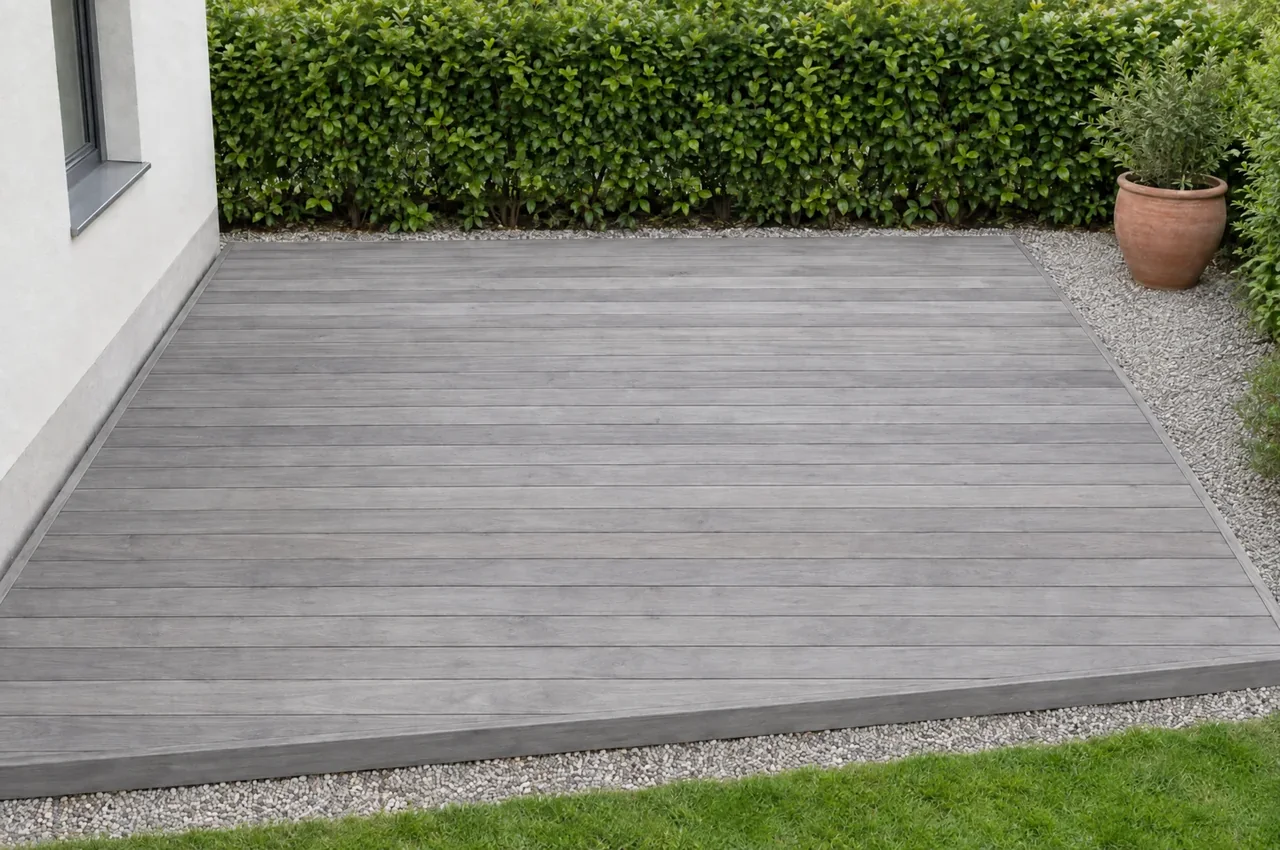
The same small deck shown with a gray surface appearance.
Illustrative ownership context. Appearance is not a service-life prediction; costs and replacement events come from the scenario inputs.Name the species and supplier
Tropical hardwood is a material family, not a complete specification. Record the actual species, board profile, purchase details, and finishing instructions attached to your project. Do not give ipe, cumaru, and batu identical assumptions merely because all are hardwoods. USDA's finishing chapter provides general background on how wood characteristics and exposure matter to finishes; it does not establish a common tropical-hardwood care interval. A generalized durability statement cannot tell you an annual cash amount or the year when a particular board will need work.
Define the appearance service
Ask whether a proposed service maintains an existing finish or restores a changed surface. For ownership modeling, a restoration quote should not be treated as an ordinary repeat visit without checking preparation and scope. Include supplies, labor, and cleanup consistently. If you intend to accept weathering, document that preference and check the care instructions supplied for your project. Excluding color-maintenance work does not justify erasing every other allowance. Retain previous finish records so future estimates can address the actual surface instead of an imagined untreated starting point.
Document replacement logistics without predicting failure
For a hypothetical board-work event, obtain a scoped allowance identifying quantity, profile, labor, delivery, and removal. Ask how a future matching product would be identified and retain purchase records. Do not assume a color or dimension will be available indefinitely, but do not invent a shortage surcharge either. Keep unresolved logistics in source notes and test an allowance range. Enter separately dated jobs separately. Recurring replacement settings describe your assumed sequence, not a species failure model, and should not be used to imply verified service life.
Hypothetical paid-care versus owner-care run
Two scenarios share $16,000 initially and a $1,000 event in year eight. One enters $180 annually for owner-purchased supplies, while the other enters $600 for a hypothetical paid service. At zero percent over ten years, totals are $18,800 and $23,000. The $4,200 cash difference excludes owner hours and does not establish equal effort or representative hardwood prices.
Common questions
Can I use a long warranty as the replacement year?
No. Read what the warranty covers separately. Its term is not a verified service life or a prediction of your future repair spending.
Does allowing weathering eliminate finish-related obligations?
Check the actual supplier's documents. An appearance preference does not override product-specific care requirements or establish that no work is needed.
Evidence & limits
- USDA Wood Handbook, Chapter 16 — general wood-finishing principles, not product care schedules
- NIST Handbook 135, 2025 — cost-method reference, not material performance or prices
Reviewed September 13, 2026. Sources support their stated technical principles; this site's workflows and hypothetical examples are not product tests, supplier approvals or independently reviewed project records.