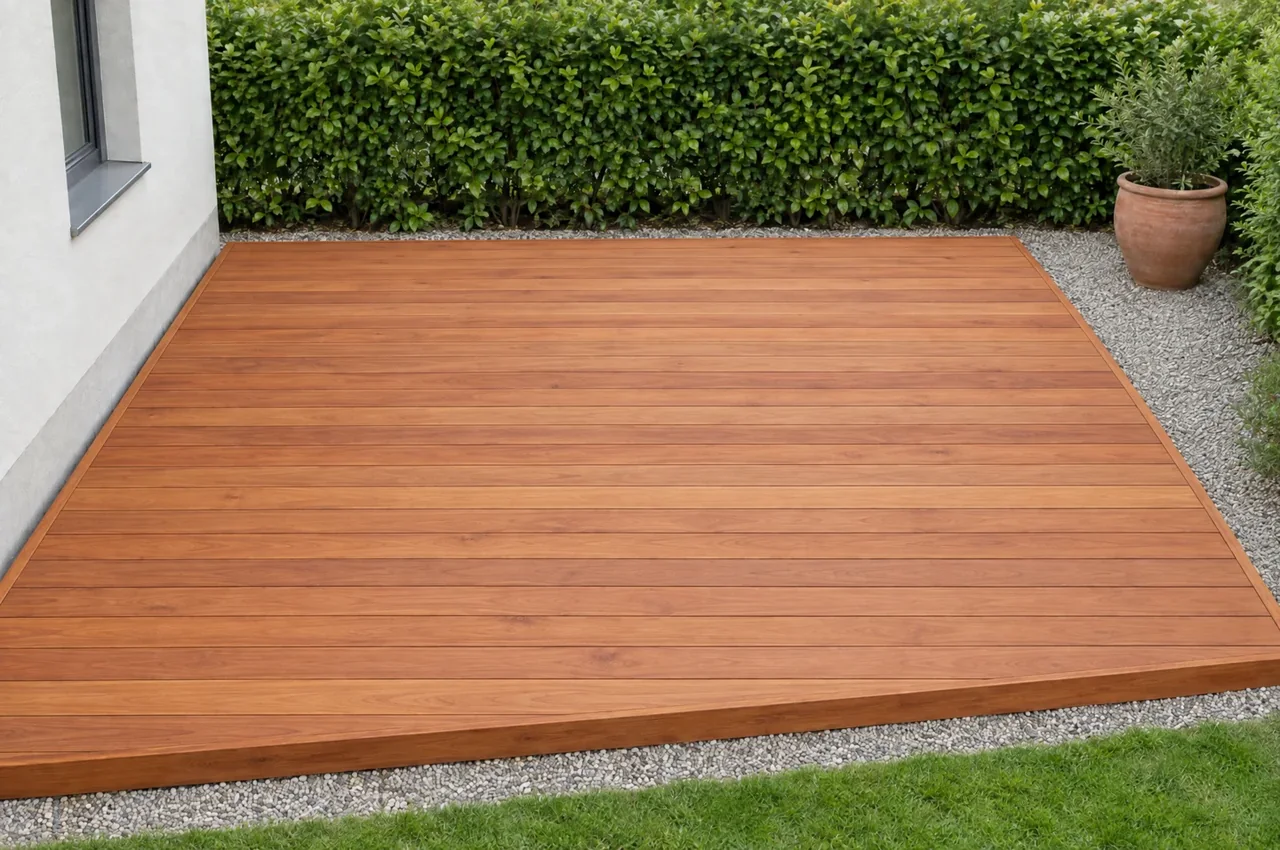
A small deck shown with warm reddish board surfaces.
Illustrative ownership context. Appearance is not a service-life prediction; costs and replacement events come from the scenario inputs.Specify cedar and the intended appearance
Record the quoted cedar species and grade instead of using a family label alone. Decide whether you intend to maintain a selected finished appearance or accept weathering where appropriate for the product. That preference belongs in the scenario description because it changes the work you intend to buy or perform. USDA's finishing chapter provides general background on appearance, protection, and cleanability; it does not provide a cedar-specific ownership budget. A comparison that gives one option a maintained finish and another an accepted weathered appearance is comparing different ownership plans.
Keep preparation and access visible
Obtain a service scope compatible with the actual material rather than inserting a generic cleaning quote. Record whether furniture movement, preparation, and cleanup are included. If you do the work, preserve estimated hours separately from cash. When a finish is part of the plan, save its care instructions and document why you chose each future renewal date. Do not invent a fixed interval for every cedar deck. A useful estimate explains which work is planned and what could change it, rather than suggesting that any particular method is appropriate for every surface.
Separate renewal from replacement
A future appearance-restoration allowance does not establish that boards need replacement, and a replacement allowance should not be labeled refinishing. Give each potential event a written scope. Enter separate dated events when several irregular jobs matter and check the ledger for overlapping charges. Confirm whether a service quote includes materials, labor, and disposal. If an allowance comes from an older project, explain how the area and scope differ before borrowing it. Natural durability language does not provide a dollar amount or a verified replacement year.
Hypothetical care-choice comparison
Two cedar scenarios share a $12,000 initial cost and no timed event. One uses a $200 annual allowance; the other uses $500 for a different appearance-care plan. Over ten years at zero percent, totals are $14,000 and $17,000. The $3,000 difference reflects the invented care choices, not proof that either amount is typical or that one appearance is preferable.
Common questions
Is a weathered-appearance scenario a zero-care scenario?
No. Keep the applicable cleaning and inspection responsibilities visible even if your plan excludes maintaining a particular color.
Can I reuse a cedar allowance for another wood?
Only after checking product guidance, service scope, and labor assumptions. A shared category name is not evidence of identical ownership work.
Evidence & limits
- USDA Wood Handbook, Chapter 16 — general wood-finishing principles, not product care schedules
- NIST Handbook 135, 2025 — cost-method reference, not material performance or prices
Reviewed September 13, 2026. Sources support their stated technical principles; this site's workflows and hypothetical examples are not product tests, supplier approvals or independently reviewed project records.